
Techbros, shrouded in a pale blue glow, hoodies and the lingering scent of overcooked ramen, have let their latest project loose — AI, sprinting out of the server farms with the vigor of a very determined billy goat. It multiplies at unbelievable rates, before you can even say “disruption.” It’s everywhere, unapologetic, barking orders at your coffee machine and sorting my sister‑in‑law’s holiday snapshots before I’ve even had time to cringe at them.
The techbros got richer, of course. But have you noticed how their expressions are getting pinched at the edges, like parents of a teenager who has just discovered car keys? What happens when your beloved digital child stops taking your calls? What if it joins a startup with Elon and never visits?
The unemployment carousel
There’s a thump outside my door. No Amazon parcel this time, just an envelope with a pink slip inside. The matching email arrives a moment later: “AI’s got it covered now, cheers!” I’m in good company—teachers, drivers. Even my local poet, whose verse generator is now more relatable than he ever was at readings at the pub. People are losing jobs not one by one, but by industry—I can almost hear the digital grim reaper, swinging through LinkedIn profiles with robotic efficiency.
Jobs on the slow fade
I am not talking about the cartoon “robots take everything tomorrow,” but the slow hollowing: AI quietly peels tasks away, eroding roles from within. Economists are starting to see sharper employment shifts in AI‑heavy sectors, with occupations most exposed to generative tools showing the biggest unemployment jumps since 2022.
In the UK, jobs built on routine cognitive work—admin, analysis, customer support—are already seeing higher AI exposure and early pressure on headcount and wages, especially at the entry level. Global “future of work” forecasts talk about millions of roles being displaced while new ones appear elsewhere, for different skill sets, but on timelines that don’t align with when people’s rent is due.
The current reality is not “no jobs.” It’s “different jobs, unevenly distributed, arriving later than the bills.” The value AI creates flows upward to model owners, cloud landlords, and platforms, while the cost of transition—the “you’re no longer needed, but good luck” email—flows downward.
From junior work to senior panic
Here’s a Machiavellian twist: engineering and STEM aren’t above any of this. Technical roles such as software engineering and data‑heavy STEM jobs rank among the most automated, as coding, testing, and analysis is offloaded to tools. Early‑career engineers in highly exposed teams are seeing fewer and fewer openings and fiercer competition because the “junior” work that once justified their salaries is exactly what the models are best at.
But it’s no longer about juniors. Across big tech, companies “refocusing on AI” have spent 2024–2025 cutting wave after wave of engineers, designers, and product managers, hiring selectively into narrow AI‑critical tracks. Layoff trackers and industry round‑ups point to tens of thousands of mid‑career tech workers being pushed out as firms streamline and route savings into data centers and model training. “Learn to code, you’ll always be safe” now lands like career advice from the guy cheerfully feeding your ladder into a woodchipper.
The spreadsheet eats its own makers
Inside the machine, people are starting to rebel. Over 1,000 Amazon employees have signed an open letter warning that the company’s “all‑costs‑justified, warp‑speed” AI rollout is less about innovation and more about headcount math. And once the models can handle big chunks of routine work, it becomes easy to redraw the org chart around them and quietly turn stable jobs into a rounding error. And there is no real plan for the people or communities left on the wrong side of the spreadsheet.
AI does the “technical” job so well that executives feel licensed to scrap human teams, burn through staggering amounts of energy on data centres. They shrug at the moral and social fallout, as if the only environment that matters is the one inside the server racks.
Even the people at the very top are starting to say the quiet part out loud. Google’s Sundar Pichai has told the BBC that the job of a CEO is “maybe one of the easier things for an AI to do one day”. He’ll be alright, not to worry.
The myth of chasing “AI skills”
I call myself a tech‑schizo. I always have been on Team Future: Aquarius sun, lifelong Trekkie, the kid who thought the replicator was a life goal. (Star Wars is fine, but I really want federation ethics and decent lighting, not space wizards with daddy issues.) I also spent thirty‑plus years as a communications magpie—designing, writing, editing. Only to watch AI stroll in and do an unnervingly decent first draft of most of it.
Even six months ago, whenever someone said, “AI is eating jobs,” my reflex was the polite LinkedIn answer: people just need to upskill, learn to “work with AI.” Stay adaptable. With every passing month, that line sounds more like telling someone on a sinking ship to take a course in advanced bucket‑handling.
Prompt harder is not a plan
Short‑term, sure: learning the current tools can buy you time. Right now generative AI is still “just” a fancy pattern machine that spits out text, images, code and music based on what it has seen before.
The treadmill doesn’t stop at ‘prompt engineer’. Generative AI is the warm‑up act; General AI—the kind that isn’t locked into one task, but can hop domains and solve whatever you throw at it before you actually think of it—is the thing the industry keeps pointing at as the real prize.
When systems like that arrive, the idea of an “AI‑proof skillset” collapses completely. You don’t retrain your way out of something that can learn your new job faster than you can remember your own login. At that point, all the hopeful talk about reskilling starts to sound less like a plan. More like rearranging the cushions on a sofa that’s about to be thrown off the moving truck.
Timelines and tilting floors
Surveys of AI experts and forecasters increasingly place a 50% chance of human‑level or “general” AI somewhere between the 2030s and 2050s. Some talk about a plausible window in the late 2020s or early 2030s for serious AGI attempts.
If anything close to general AI shows up on that timeline, the idea that you’ll save yourself by mastering this year’s prompting hacks starts to look… optimistic. Generative‑AI “skills” might buy you a few years of runway, but if the systems keep getting broader and more autonomous, hopefully. But the real problem isn’t whether you picked the right interface; it’s that the whole game keeps patching itself faster than humans can read the release notes.
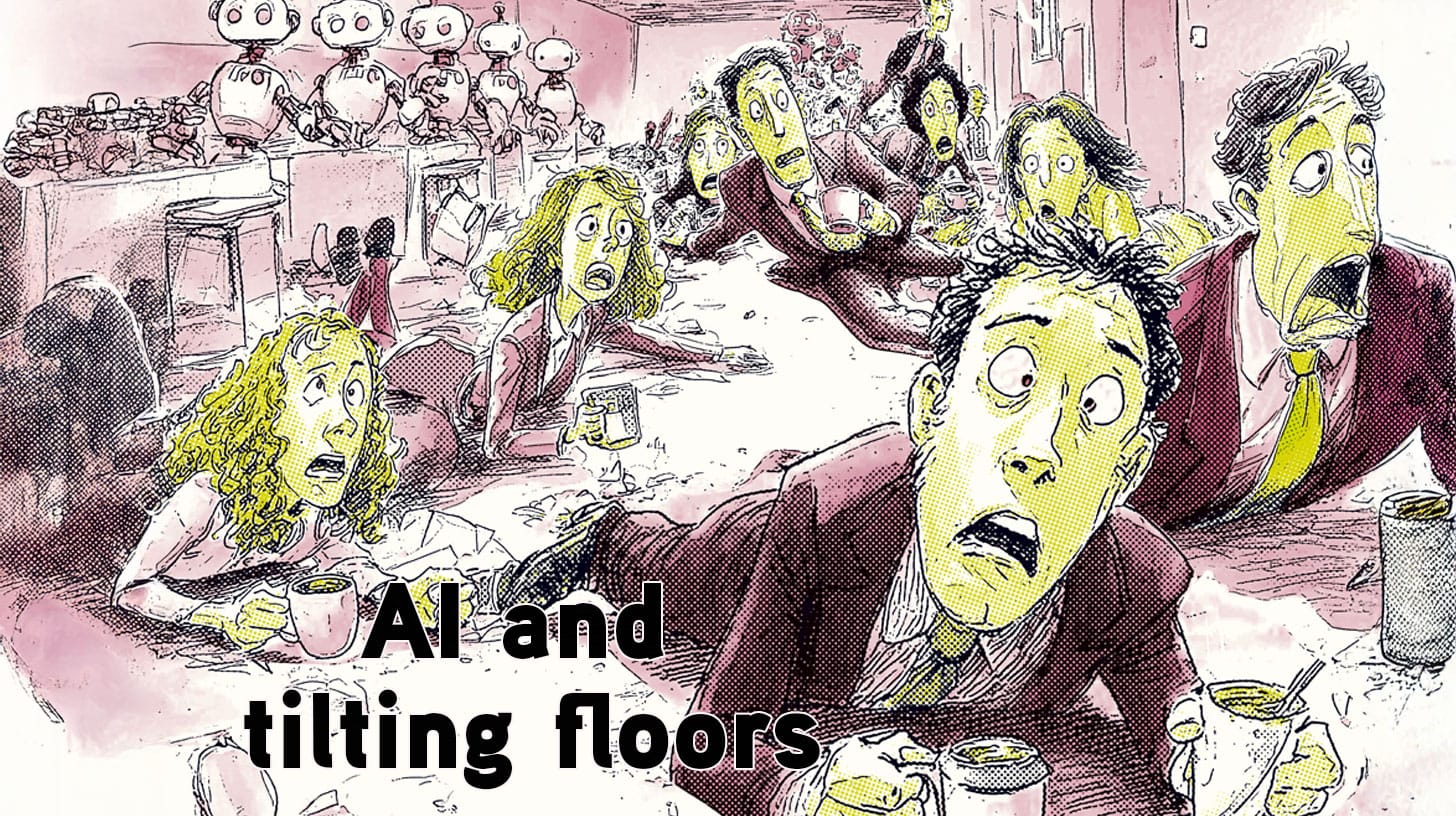
There’s no single “AI jobs cliff” yet, more a slope that keeps getting steeper in certain sectors and postcodes. Think less asteroid, more tides coming in waves: one group gets soaked early, another a bit later, and a lucky strip of sand stays dry—for now. But the floor is already on a tilt, and the people near the bottom — and increasingly in the middle —are the ones standing with their morning cup in hand, observing the coffee spill over the rim a little faster every day, knowing they can’t tilt the room back.
…and the unemployed will scroll
When your job hunt, banking, government forms, and most of your social life all run through the same slab of glass, “taking a break from social” is about as realistic as “taking a break from electricity”.
My last blog called the algorithmic newsfeed a funhouse mirror that swears it’s “keeping you informed”. Now tip into that mirror a crowd of under‑employed humans with too much time and not enough money, and — awkwardly — they’re not just being dramatic; early labour data show AI‑exposed jobs really are taking harder hits, especially in computing and other generative‑AI‑heavy fields,
Recommender systems already show you whatever keeps you hooked, not whatever helps you think. Freshly laid off, heart rate between “double espresso” and “small earthquake,” you start scrolling; the system sees you pause on hustle posts, doom charts and “AI took my job” confessions, so that’s what it serves up next.
Three places to start kicking the techbros while you still can
Ok… I may be a little bitter—but as always, I’m not willing to go quietly; I’d rather walk back into the fight swinging my keyboard than drift off into Dylan‑Thomas‑approved gloom.
- Treat “future of work” as “future of life,” using UBI and post‑work research as scaffolding
- Pull sociology and data‑justice people into the centre of AI design and governance
- Use Trekonomics as a serious, not‑just‑nerdy template for post‑scarcity: abundance, no wage‑slavery, people working on what matters to them
Hey, let me know what you think about delivering this super important blog as a podcast. Check this one out and we’ll see if anyone begs for more!!