
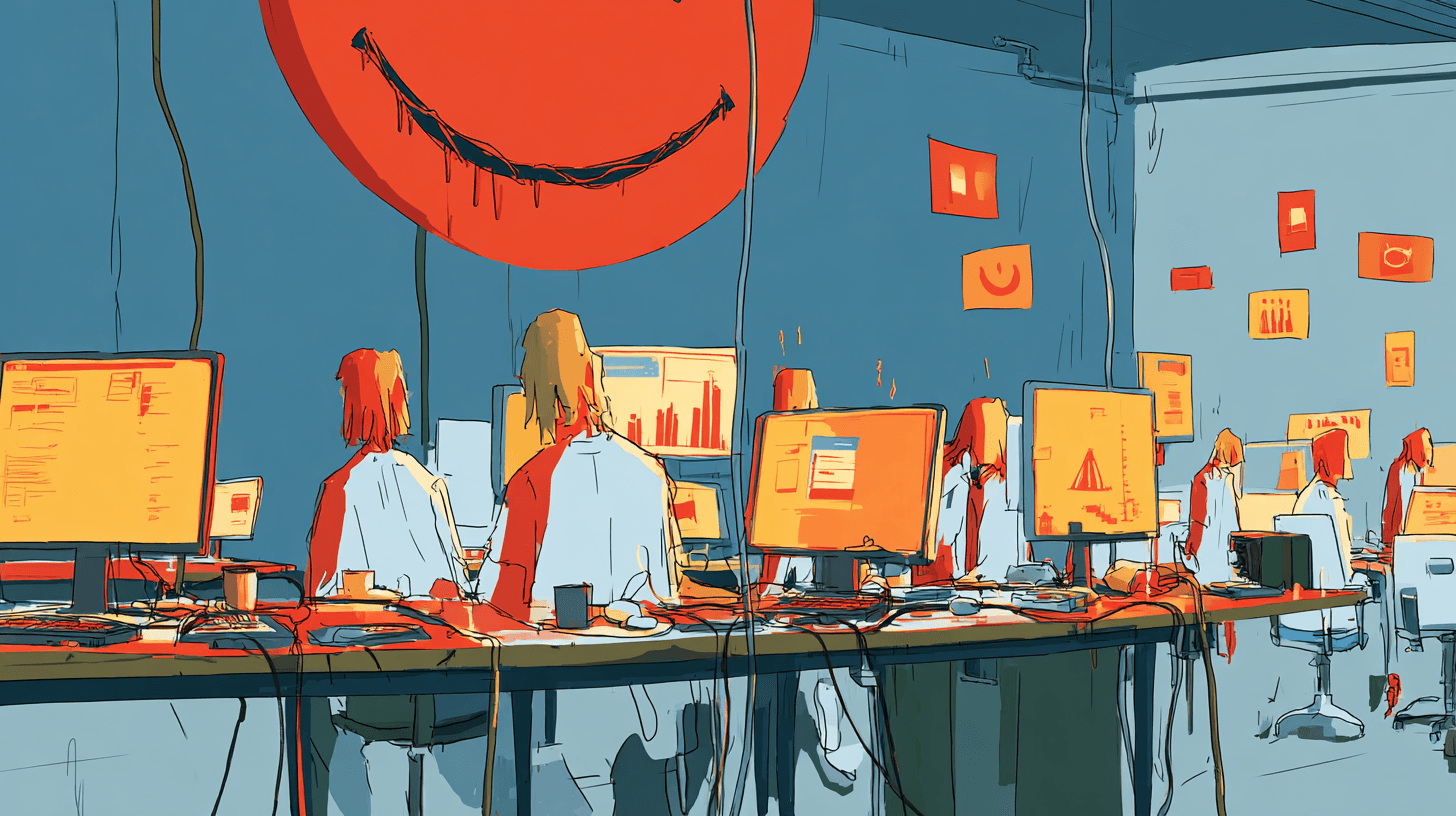
There is a new office sport in the corporate world. It’s not shipping good products or services. It’s running up the score on how many chunks of text you can shove through an AI system every week.
Somewhere in a glass building, a dashboard lights up: who used the most AI today? Who fed the machine the most? Who is the most “future‑ready”, according to a metric that measures only how hard you press the autocomplete button as you help automate yourself, because the rent is due either way.
Welcome to tokenmaxxing – work, as seen through a Las Vegas slot machine.
How to win at Amazon’s AI Hunger Games
At Amazon, productivity today means how aggressively you can point an internal AI tool called MeshClaw at your inbox and let it chew through emails, tickets, and Slack messages, whether that helps anyone or not.
MeshClaw was built to “automate repetitive tasks”. In practice, employees use it to automate extra, unnecessary tasks purely to inflate their AI usage numbers and climb internal leaderboards.
Management, of course, insists that none of this is about performance. The AI usage dashboards are “for visibility”, “for learning”, “for experimentation”.
Anyone who has ever worked in a company knows how that goes. If your manager can see a number next to your name, that number will, sooner or later, stand in for whether you are “leaning in” or “resistant”, “excited” or “lagging”, “safe” or “the next one out”.
So, staff react rationally to an irrational system. They route more and more work through MeshClaw. They don’t optimise their work; they optimise their stats.
None of these numbers capture what actually keeps a business alive: knowing when to say no, knowing who to call, and quietly preventing expensive stupidity before it spreads.
Meta’s internal AI flex‑off
Employees at Meta briefly had an internal leaderboard called “Claudeonomics” that tracked how many AI tokens – tiny pieces of text processed by a model – each employee burned. It highlighted the top “super users” and handed out titles like “Token Legend” and “Model Connoisseur”.
After the dashboard leaked, the company killed it, but the broader push to make AI “core to how we work” stayed firmly in place. It turns skilled people into human wrappers around a jumble of chatbots and half‑baked internal apps.
Designers who once spent most of their time thinking through flows and the weird problems at the edges now find themselves editing AI‑generated sludge into something a human can read, sitting in meetings about where to wedge “AI features” into products, and documenting which tools they used so they can tell a convincing AI story at review time.
Their impact is still judged on the usual things – growth, launches, whether users hate what they’re given – but hovering in the background, like a new religion, is the question: “Are you AI enough?”.
AI usage, now with some shareholder panic
Tokenmaxxing is a very ridiculous response to a very real problem.
Tech giants have poured an eye‑watering amount of money into AI infrastructure. Amazon alone has told investors it expects roughly 200 billion dollars of capital spending in 2026, most of it on AI and data centres.
They now have to prove – to boards, to shareholders, to each other – that this was not just a very expensive way to set fire to electricity.
You can, however, show it by counting tokens.
- Look, usage is up.
- Look, more than 80 percent of developers touched AI this week.
- Look, we have graphs and heat maps and leaderboards.
It’s the corporate equivalent of watering plastic plants so the soil looks damp for visitors.
The part where reality still needs humans
People inside this farce see what’s going on. Some lean into the game; if the company wants tokens, they’ll give it tokens. They build what look like “AI agents” and “workflows” that mostly exist to keep the graphs pointing up.
Others look at these dashboards the way you’d look at a slot machine someone has bolted onto your desk.
Meanwhile, the work that still keeps anything running hasn’t gone anywhere.
Goods still have to get across borders without rotting or getting stuck in customs. That depends on people who know the rules, know the inspectors, and remember the awkward regulations that never fit into neat forms or clean datasets.
Software still has to be designed so people don’t feel tricked, stalked, or don’t get the interface. Those people now find themselves judged informally, if not formally, on how many times a day they ask a chatbot to rewrite an email – as if pressing “paraphrase” were the same thing as doing good work.
Measurable beats meaningful, every time
Tokenmaxxing doesn’t optimise for meaningful. It optimises for measurable.
There’s a simple test you can apply to any of these AI tools: if the company turned all the dashboards off tomorrow – no token counts, no usage charts, no AI‑week participation slides – which parts would workers still use voluntarily?
Whatever’s left after that is the bit that’s actually worth keeping.
Reward the person who hits ‘cancel’
Right now, only one kind of behaviour gets a number next to it: how often you use AI. Imagine if the dashboard also tracked the times humans stepped in and refused to let a bot drive a decision – and got credit for it.
A designer killing an useless “smart nudge”. A logistics lead refusing to let MeshClaw email a regulator. Those are not acts of Luddism; they’re acts of risk management and care.
If companies want to be “AI‑first”, fine. They should also be “human‑override proud”. A recorded, rewarded “we didn’t let the AI do this” should count as a success, not a private shame.
Tax the bots, fund the humans
Capitalism understands one language very well: price. Right now, wasted compute is cheap and quiet; humans are expensive and noisy. Guess which one gets trimmed first.
Let’s introduce a “waste AI” levy: companies above a certain size pay a small tax on AI compute that is not demonstrably tied to safety, accessibility, or public benefit.
Pair it with a “human craft” deduction: companies get tax breaks for roles whose job description explicitly centres human judgment, relationship work, care, and safety — and where there is a written, enforceable limit on what AI is allowed to do in that role, and beyond that line only a human can act.
Suddenly it’s slightly more expensive to run a hundred pointless MeshClaw agents than to keep the human who actually knows how to move goods across a border without creating a diplomatic incident.
If that sounds radical, it’s only because it says the quiet part out loud: some work is valuable precisely because it is human, and our tax rules might want to stop pretending otherwise.
Change what investors are allowed to count
Right now, investors treat “AI adoption” as a shorthand for “future cash”, so CEOs behave accordingly.
Governments could require large, listed companies that brag about AI on earnings calls to publish an AI impact statement next to the numbers:
- section A energy and resource cost of AI experiments
- section B measurable business value (revenue, cost savings, safety improvements)
- section C measurable harm or risk events (security incidents, regulatory interventions, major UX backlashes)
- and ban “raw AI usage” metrics (tokens, calls, agent‑hours) from investor materials unless sections B and C are reported just as prominently
This approach can turn AI from a free PR story into a line item that has to survive contact with reality aka humanity. If a corporation wants to flex about AI on an earnings call, show the compost heap as well as the flowers.